

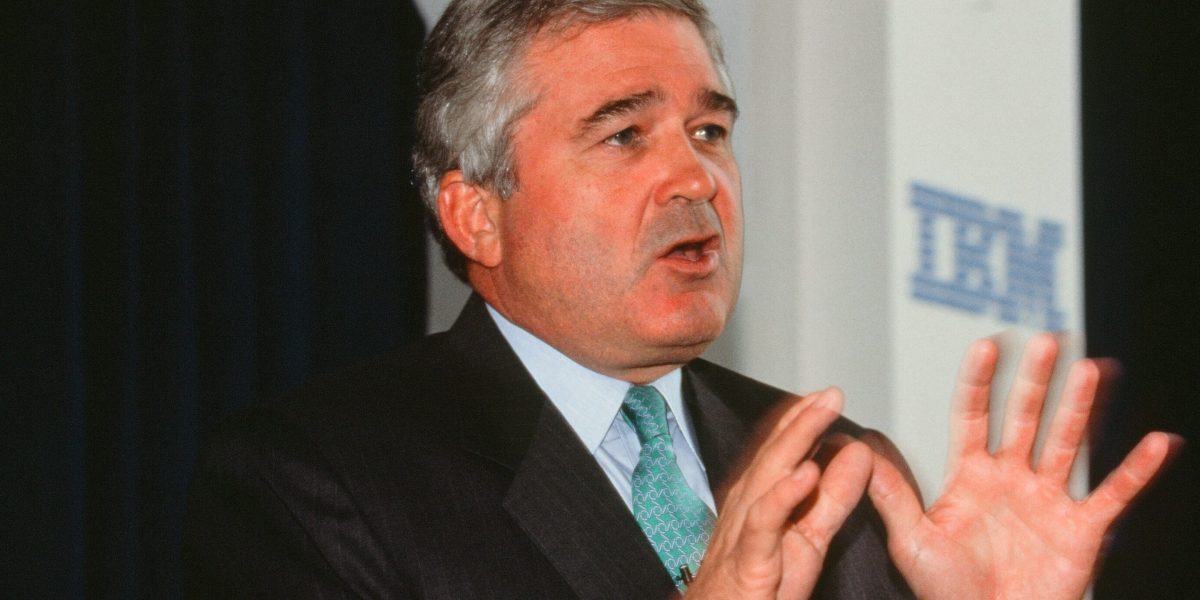
Louis Gerstner, who took over International Business Machines Corp. when it was on its deathbed and resuscitated it as a technology industry leader, died Saturday. He was 83.
IBM chairman and CEO Arvind Krishna announced Gerstner’s death in an email sent Sunday to its employees, but didn’t provide a cause of death.
Gerstner’s nine-year tenure as chairman and CEO of the company known as “Big Blue” is often used as a case study in corporate leadership.
On April Fool’s Day, 1993, he became the first outsider to run IBM, which was facing a choice of bankruptcy or dismemberment after a period when it had been the undisputed leader in personal computers and mainframes. He pivoted the Armonk, New York-based company toward business services and away from hardware production, reversing a move to break up the company into a dozen or more semi-autonomous units — “Baby Blues” — in pursuit of greater profits.
Gerstner slashed costs and sold off unproductive assets, including real estate and IBM’s collection of fine art. He fired 35,000 of the 300,000 employees, who had become accustomed to a culture of lifetime tenure based on principles established by former CEO Thomas Watson Sr. in the early 20th century.
He stressed company-wide teamwork to replace the tradition of loyalty to various divisions, and he pegged compensation to corporate performance rather than individual results. To meet performance goals, he emphasized regular accountability rather than waiting for yearly performance reviews.
“People do what you inspect, not what you expect,” he said.
Gerstner’s key change was to scrap IBM’s culture of selling bundled products that only worked with other IBM goods, from PCs to operating systems to software. Products he considered losers were jettisoned. He pulled the plug on OS/2, an operating system intended to challenge Microsoft’s Windows that hadn’t proved popular with customers.
“His leadership during that period reshaped the company,” Krishna wrote. “Not by looking backward, but by focusing relentlessly on what our clients would need next.”
Focus on Middleware
IBM put its focus on so-called middleware — software for databases, systems management and transaction management. The company became the impartial integrator for companies’ networks and systems, happy to help whether the hardware used had the IBM name on it or not.
Gerstner made an early bet on the internet and e-business, which he guessed correctly would put less emphasis on personal computers and more on servers, routers and other more sophisticated equipment that would benefit from IBM’s service know-how and involve buyers familiar to IBM’s sales force, such as chief technology officers.
Later in his tenure, he also made some strategic acquisitions such as the $2.2 billion paid for Lotus Development Corp., whose Notes product was vital for helping IBM customers collaborate on an enterprise-wide basis.
The switch in focus from hardware to services resulted in an increase in services revenue from $7.4 billion in 1992 to $30 billion in 2001. IBM’s share price went from $13 to $80 in his nine years as CEO, adjusted for splits,.and IBM’s market value rose from $29 billion to about $168 billion in that period.
“If I had a vote, the most significant legacy of my tenure at IBM would be the truly integrated entity that has been created,” he wrote in Who Says Elephants Can’t Dance? Leading a Great Enterprise through Dramatic Change (2002). “It certainly was the most difficult and risky change I made.”
Louis Vincent Gerstner Jr. was born on March 1, 1941, in Mineola, New York, to Louis Gerstner Sr., a milk truck driver, and Marjorie Rutan, a secretary and college administrator. He was one of four brothers.
He graduated from Mineola’s Chaminade High School, a competitive Catholic institution. He got an engineering degree from Dartmouth College and an MBA from Harvard University.
McKinsey Partner
After Harvard he joined McKinsey & Co. as a consultant. He made partner in four years and spent 12 years there before taking a job with American Express.
He worked for the credit-card division there, then took over travel-related services. Under his leadership, Amex, which offered primarily a travel card at that point, increased its presence in retail stores and created premium cards that permitted customers to carry unpaid balances.
With his way to the top of management at Amex blocked by CEO James D. Robinson III, Gerstner agreed to run RJR Nabisco Inc., where he stayed four years before joining IBM. His primary focus at RJR Nabisco was to reduce the $25 billion in debt produced by the leveraged buyout that created the tobacco and consumer products firm.
IBM’s board began its search for a new CEO after it forced out John Akers in January 1993, just as the company was reporting its largest annual loss. In selecting Gerstner, the board chose managerial experience over computer expertise. (Gerstner’s brother Richard had worked for IBM for 30 years and headed the division that included personal computers.)
From Gerstner’s first day in April 1993 until the January 2002 announcement that he was stepping down, IBM’s shares rose ninefold while the Standard & Poor’s 500 Index gained 154%. Sam Palmisano succeeded him, first as CEO, then as chairman when Gerstner retired at the end of 2002.
In 2003, Gerstner became chairman of the Carlyle Group, the Washington-based private-equity firm. He oversaw the firm’s expansion into Asia and Latin America and early preparations for going public, which it did in 2012. He retired in 2008, remaining as a senior adviser.
With his wife, Robin, he had two children. Their son, Louis III, died in 2013 after a choking accident in a restaurant.
Through Gerstner Philanthropies, the family has supported biomedical research, environmental and education programs, and social services in New York City, Boston and Florida’s Palm Beach County. The family has been a longtime supporter of the Mayo Clinic.
