

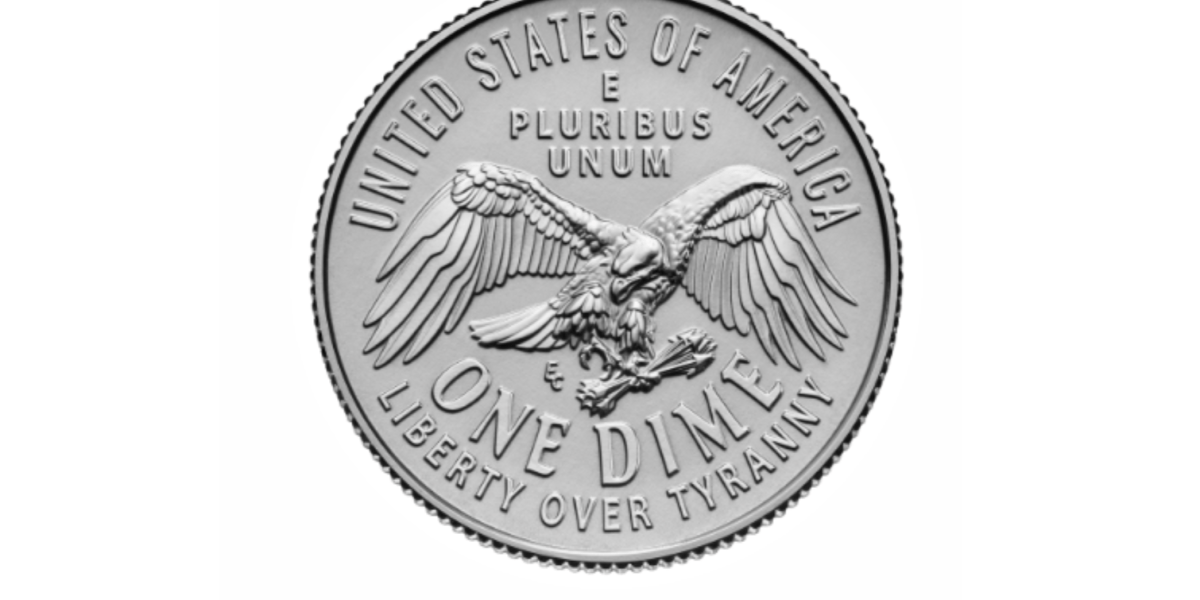
The U.S. Mint unveiled new designs for the country’s 250th anniversary and it left out one key detail: the olive branch from the newly designed dime. The new reverse shows a bald eagle mid-flight, arrows clutched in its left talon and nothing—where an olive branch once lived—in its right, with beneath, the inscription “Liberty over Tyranny.”
For a nation whose founding symbols were carefully engineered around the balance of peace and war, that omission is hard to read as accidental.
Unchanged since 1946, the Roosevelt dime is now replaced by a modern Liberty figure on the front, solely for one year as the country celebrates its 250th anniversary this year. The U.S. Mint is marking the Semiquincentennial with a sweeping redesign of the coinage, something not undertaken since the 1976 Bicentennial. Authorized by Congress, the change touches the dime, quarter, half dollar, penny, and dollar coin, all bearing 1776–2026 dates.
The olive branch has anchored American iconography for 250 years—its absence from the very coin marking that anniversary is a curious choice, if not a telling one.
What does the olive branch mean?
When the Great Seal of the United States was finalized in 1782, it contained what the Founding Father’s held as the country’s most esteemed values. The eagle holds 13 arrows in its left talon and an olive branch in its right, its head turned toward the branch—the side which the eagle preferred to err on.
The arrows—not for lack of symbolism, take a wild guess why there are 13 of them—are in the eagle’s left talon, the traditionally thought-of weaker and subordinate side. Meant to represent the power of war and military preparedness, the arrows clutched in the left talon signal that although the U.S. is always armed and ready, force is not its first instinct.
Charles Thomson, who shepherded the final design, was explicit: the arrows represented the power of war, the olive branch the power of peace, and together they carried a single message: the United States had a strong desire for peace, but would always be ready for war.
The eagle’s head facing the olive branch was not incidental. It was a statement of national preference, drawn directly from the Olive Branch Petition of 1775, Congress’s last diplomatic appeal to King George III before the war escalated beyond return.
Dropping the olive branch from the dime isn’t just a design choice: it’s a cultural signal. The Founders spent six years perfecting the balance between peace and war on the Great Seal. Erasing half of that equation, on a coin meant to celebrate their legacy, and especially 250 years after they fought for “Liberty over Tyranny,” says something about which half the country currently feels like.
What was the coin design process?
The U.S. Mint is also redesigning other currency. Five new one-year-only quarter designs trace American history from the Mayflower Compact to the Gettysburg Address. Acting Mint Director Kristie McNally said the goal was for every American to hold 250 years of history in their hands.
“The designs on these historic coins depict the story of America’s journey toward a ‘more perfect union,’ and celebrate America’s defining ideals of liberty. We hope to offer each American the opportunity to hold our nation’s storied 250 years of history in the palms of their hands as we Connect America through Coins.”
In 2025, the U.S. Mint brought the coin designs to the public, with the top rated coins reviewed and recommended by the Citizens Coinage Advisory Committee (CCAC) and U.S. Commission of Fine Arts (CFA). The CCAC, established in 2003, advises the Secretary of the Treasury on themes and designs of all U.S. coins and medals, the latter of which are used in commemoration and neither hold face value nor are legal tender. The CCAC, an informed and impartial resource for the Secretary, essentially, is meant to represent the interests of all Americans. The Secretary then approves all final suggestions.
In Sept. 2024, the coin designs were put into review. Each coin design will depict a special Semiquincentennial Liberty Bell with the numeral “250” marked on the coin.
Coins and their symbolism
In Dec. 2025, Secretary of the Treasury Scott Bessent nixxed some of the quarter designs that were approved by then-Treasury Secretary Janet Yellen during the Biden Administration for focusing “on DEI and Critical Race Theory policies.” One of the coins featured a line of people with arms linked, in between the words “We shall overcome.”
At the time, U.S. Treasurer Brandon Beach said the coinage design is supposed to “celebrate American history and the founding of our great nation,” but that imagery was scrapped because “the Biden Administration and Secretary Yellen remained focused on DEI and Critical Race Theory policies.”
“The Trump Administration is dedicated to fostering prosperity and patriotism. We have no doubt these new designs will be wildly popular with the American people.”
U.S. Mint
It’s interesting to note, however, the 1916 Standing Liberty Quarter, a medal that also will be released this year in commemoration of the 250th anniversary (dubbed by the Mint as the SemiQ), features a standing Liberty holding an olive branch on the front, and on the back, the talons of an eagle gripping an olive branch.
Perhaps the most famous dime is the Mercury dime which was minted between 1916 and 1946. Designer Adolph Weinman chose to use a Roman fasces—an axe bound tightly in a bundle of rods—wrapped in an olive branch, together symbolizing military readiness tempered by a desire for peace, in a nod to the Roman Republic. Three years after the Mercury dime debuted, Benito Mussolini adopted the fasces as the emblem of his Italian fascist movement (even where the name derived from), and permanently darkened the symbol’s meaning, forcing President Franklin D. Roosevelt to replace the dime in 1946.
