
Close Menu
  • Home
  • Financial
  • News
  • Personal Finance
  • Real Estate
  • Debt Relief
  • Subscribe Now
What's Hot

The uncomfortable truth about AI and the American worker | Fortune

April 29, 2026

What is a Buyer’s Market?

April 28, 2026

Flippers Are Feeling Most Bullish in Months, Here’s Why

April 28, 2026
Facebook X (Twitter) Instagram
creditreddit.org
Subscribe Now
  • Home
  • Financial
  • News
  • Personal Finance
  • Real Estate
  • Debt Relief
  • Subscribe Now
creditreddit.org
Home » Asia rolls out four-day weeks and work-from-home as emergency measures to solve a fuel crisis caused by Iran war | Fortune
Financial

Asia rolls out four-day weeks and work-from-home as emergency measures to solve a fuel crisis caused by Iran war | Fortune

joshBy joshMarch 12, 2026No Comments3 Mins Read0 Views
Facebook Twitter Pinterest Telegram LinkedIn Tumblr Copy Link Email
Follow Us
Google News Flipboard
Asia rolls out four-day weeks and work-from-home as emergency measures to solve a fuel crisis caused by Iran war | Fortune
Share
Facebook Twitter LinkedIn Pinterest Email Copy Link


Closed schools. Work-from-home demands. Price caps.

Asia’s governments are scrambling to manage a fuel shortage caused by high oil prices and a closed Strait of Hormuz. Asia is particularly dependent on oil exports from the Middle East; Japan and South Korea respectively source 90% and 70% of their oil from the region.

The energy crunch is forcing governments to adopt more extreme measures to save fuel.

On March 10, Thailand ordered civil servants to take the stairs rather than the elevator, and to work-from-home for the duration of the crisis. It increased the air-conditioning temperature to 27 degrees Celsius, and will tell government employees to wear short-sleeved shirts over suits. (Thailand has about 95 days of energy reserves left, according to Reuters).

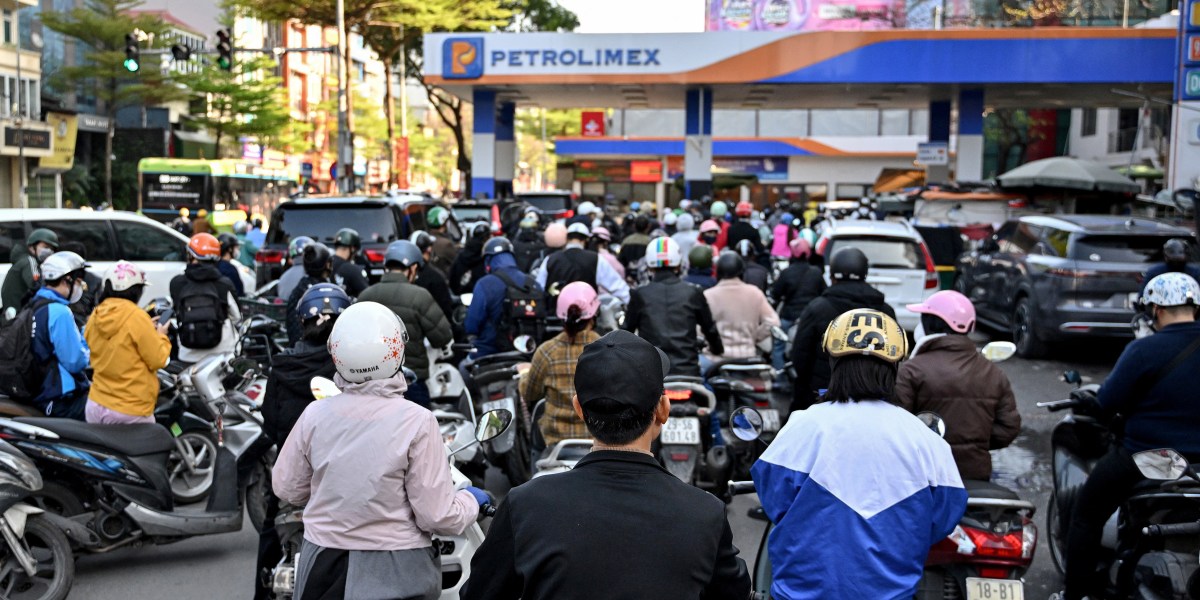
Vietnam also called on businesses to let people work-from-home to “reduce the need for travel and transportation.” The Philippines is pushing for a four-day work week, and has ordered officials to limit travel “to essential functions only.”

South Asia is getting hit hard too. Bangladesh brought forward the Eid-al-fitr holiday, allowing universities to close early in a bid to save fuel. Pakistan also instituted a four-day week for government offices and closed schools. India suspended shipments of liquefied petroleum gas to commercial operators to prioritize supplies for households, leading to worries from hotels and restaurants that they may be forced to close without fuel supplies.

Asian countries are also intervening more directly into fuel markets.

South Korean President Lee Jae Myung on Monday said the country would introduce a price cap on petroleum products, and warned that the current crisis presented a “significant burden on the country’s economy.” Around 1.7 million barrels of Korea-bound oil has been held back per day due to the ongoing conflict, presidential policy advisor Kim Yong-beom noted during a March 9 press briefing.

Ryosei Akazawa, Japan’s industry minister, didn’t rule out dipping into Japan’s national oil reserves on Wednesday, adding the country “will take all possible measures to ensure stable supplies of energy”.

On Monday, Indonesia’s finance minister said the Southeast Asian country would set aside 381.3 trillion rupiah ($22.6 billion) for energy subsidies and pay state energy firms like Pertamina to keep fuel and electricity prices affordable for its residents. 

Thailand plans to freeze cooking gas prices until May, and encourage consumers to use alternative energy sources, like biodiesel and benzene. Vietnam is also considering scrapping its tariffs on fuel imports. 

Oil prices have had a volatile few days. WTI crude prices surged to over $115 per barrel on Monday, only to swing back and forth as competing statements emerged from Washington. WTI Crude is now past $90 per barrel, as of Wednesday evening.

On March 11, the International Energy Agency’s 32 member countries unanimously agreed to release 400 million barrels of oil from their emergency reserves.

Flows from the Middle East are still constrained, with the Strait of Hormuz effectively closed to maritime traffic. “While oil reached $150/bbl [per barrel] in inflation-adjusted terms during the 2022 Russia/Ukraine crisis, this situation could prove more severe…supply volumes at risk this time are dimensionally bigger—and real,” wrote Wood Mackenzie analyst Simon Flowers in a research note. “In our view, $200/bbl is not outside the realms of possibility in 2026.”

Asia caused Crisis emergency Fortune fourday fuel Iran measures rolls solve war weeks workfromhome
Follow on Google News Follow on Flipboard
Share. Facebook Twitter Pinterest LinkedIn Telegram Email Copy Link
josh
  • Website

Related Posts

The uncomfortable truth about AI and the American worker | Fortune

By joshApril 29, 2026

‘The cost of compute is far beyond the costs of the employees’: Nvidia exec says right now AI is more expensive than paying human workers | Fortune

By joshApril 28, 2026

DOJ uses White House correspondents’ dinner shooting to pressure preservations to drop lawsuit over Trump’s $400 million ballroom | Fortune

By joshApril 26, 2026

Trump says shooting by ‘would-be assassin’ points to need for White House ballroom as questions are raised about security at correspondents dinner | Fortune

By joshApril 26, 2026

Even as businesses spend $4 million to cross Panama Canal, they say ‘it’s safer and less expensive’ than the Strait of Hormuz | Fortune

By joshApril 24, 2026

Intel CEO Lip Bu Tan crushed Wall Street targets on his 1-year anniversary: We are embracing our ‘paranoid’ roots | Fortune

By joshApril 24, 2026
Add A Comment
Leave A Reply Cancel Reply

Top Posts

How to Build a More Predictable Financial Routine

November 24, 2025233 Views

Social Security payments to go up 2.8% next year while polls show three-fourths of seniors think 3% isn’t enough to keep up with rising prices | Fortune

October 24, 202542 Views

Trump Floats 50-Year Mortgages: Cash Flow Boost or Affordability Illusion?

November 13, 202540 Views

Why Mortgage Rates are Rising as the Fed Keeps Cutting

November 4, 202533 Views
Don't Miss

The uncomfortable truth about AI and the American worker | Fortune

April 29, 20266 Mins Read0 Views

Surveys consistently show that workers dread artificial intelligence. They worry it will render their skills…

What is a Buyer’s Market?

April 28, 2026

Flippers Are Feeling Most Bullish in Months, Here’s Why

April 28, 2026

‘The cost of compute is far beyond the costs of the employees’: Nvidia exec says right now AI is more expensive than paying human workers | Fortune

April 28, 2026
Demo
Our Picks

The uncomfortable truth about AI and the American worker | Fortune

April 29, 2026

What is a Buyer’s Market?

April 28, 2026

Flippers Are Feeling Most Bullish in Months, Here’s Why

April 28, 2026
Most Popular

The markets’ reaction to Trump hides a darker truth that puts the American economy at risk, Piper Sandler warns | Fortune

August 26, 20250 Views

Investors Are Controlling the Housing Market

September 4, 20250 Views

Local Politics is Ruining the American Dream With Overbearing Regulations

September 4, 20250 Views
  • Home
  • Privacy Policy
  • Terms and Conditions
  • Subscribe Now
© 2026 ThemeSphere.

Terms & Conditions | Privacy Policy

Type above and press Enter to search. Press Esc to cancel.