

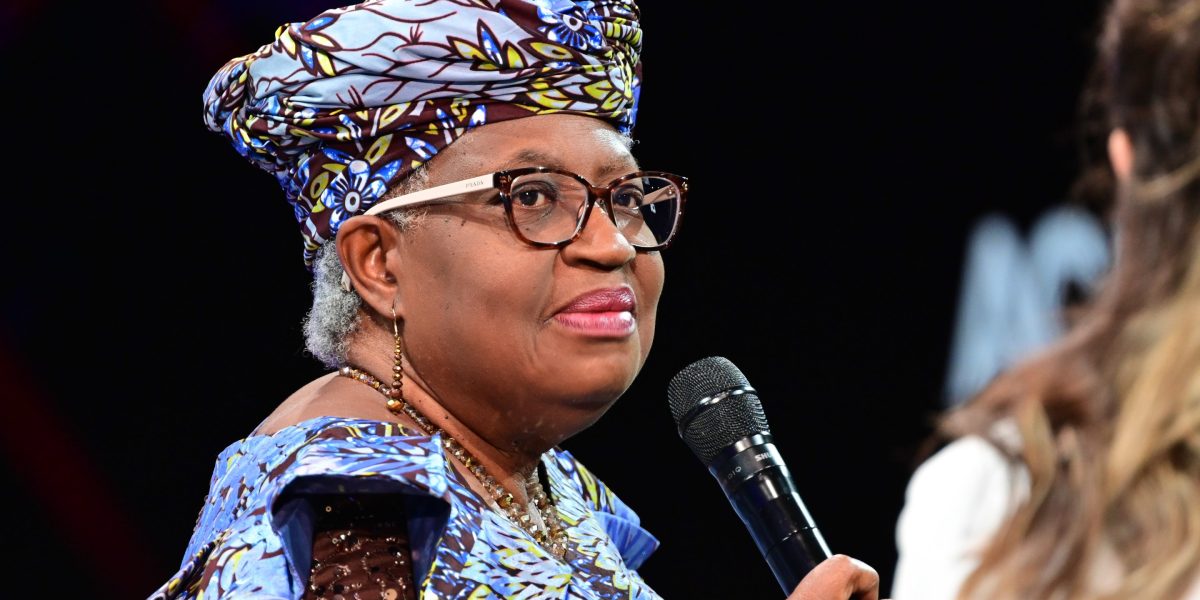
“I think it’s maybe understatement of the century to say that global trade is facing the greatest disruption in 80 years.” It’s a significant statement from anyone, let alone Dr. Ngozi Okonjo-Iweala, the director-general of the World Trade Organization. She warned at the Fortune Global Forum in Riyadh that the global economy is in its choppiest waters since the 1930s, no small feat considering that decade saw the Great Depression and the outbreak of the Second World War — and the Great Recession of 2008 is still in living memory.
Still, Dr. Okonjo-Iweala, a Nigerian economist who is the first woman and the first African to lead the World Trade Organization as director-general, insisted that what’s happening isn’t a replay of that dark decade in the early 20th century. “It is functioning,” Dr. Okonjo-Iweala said of trade, but it’s not functioning quite in the way it used to before. This is due to President Donald Trump enacting several sudden changes to world trade that reflect what he considers flaws in the system. “I think that a lot of the criticisms made by the U.S. of the system are valid,” the former Nigerian minister said, urging the audience to use this opportunity for wider reform.
Speaking in a wide-ranging discussion on the future of the global trading system with Fortune‘s Ellie Austin at the Fortune Global Forum in Riyadh, Dr. Okonjo-Iweala argued that despite rising tariffs, broken supply chains, and the resurgence of economic nationalism, the WTO-led framework has shown surprising resilience. “Before the current wave of tariff disputes, roughly 80% of global trade operated under WTO’s most-favored-nation rules,” she said, noting that this has dropped to about 72 %, “but the important thing is that the system is still holding.”
Surprised and pleased with resilience
Dr. Okonjo-Iweala acknowledged that the scale of disruption rivals the protectionist spiral of the interwar years, yet emphasized that key differences have prevented history from repeating itself. “What we see now is the fact that we’ve talked to members to avoid their tit-for-tat,” she said, referring to an escalating cycle of protectionism and tariff walls going up everywhere between economies. Most WTO members have not done that, she added. “I’m very proud of them … they are all still trading with themselves, mostly on WTO rules.”
While the United States — which accounts for nearly 30% of global imports — has challenged existing trade rules and bypassed dispute settlement mechanisms, the director-general stressed that the WTO framework remains indispensable. The U.S. may be operating differently, she said, but 87 % of world trade continues to be governed by WTO disciplines. “We were surprised and pleased at the resilience of the system.”
The director-general outlined an ambitious reform agenda to restore confidence in global governance. Central to her proposal is modernizing the WTO’s consensus decision-making process, which requires unanimity among all 166 members. Unanimity sounds noble, she said, “but sometimes you really get stuck.” She said the answer is simple but difficult: “The members have to work at it. Okay? It’s up to them to come up with the answers.”
Greater transparency in subsidies and trade reporting, she added, will be critical. “If you don’t have a level playing field, and practices are not seen to be fair, that really does undermine the system,” she said.
A new plumbing system?
The director-general compared the WTO’s role to “the plumbing” of the global economy — “you don’t think of it until the pipe breaks.” From intellectual property protections to valuation rules for cross-border goods, she said these often-overlooked standards sustain trillions of dollars in commerce each year.
She also highlighted how deeply many smaller economies rely on rules-based trade: Out of 166 members, 142 have trade-to-GDP ratios above 50%, and they “really depend on trade and need the rules. You can’t make an agreement with every single country, so you need multilateral rules and a level and a system that provides stability and predictability.”
Turning to the future, Dr. Okonjo-Iweala said the next wave of reforms must address the rapid expansion of digital and AI-driven commerce. Roughly 40% of global trade in the past year involved AI-related goods such as semiconductors, telecoms, and advanced computing. Digitally delivered services alone are worth nearly $5 trillion, growing at 8% annually — twice as fast as the trade in goods.
Artificial intelligence, she continued, has the potential to dramatically reduce trade costs while shifting the nature of goods and services exchanged. That transformation demands new plumbing, or new global rules. To that end, the WTO has convened a group of nearly 70 members to negotiate a landmark e‑commerce agreement — the first of its kind — with a first phase expected by the March 2026 ministerial conference.
Despite uncertainty, Dr. Okonjo-Iweala framed the current crisis as a pivotal opportunity for renewal. “In every crisis, there’s always opportunity,” she said, seeming to imply that the world is ripe for new pipes under the surface. So it’s a relief that the 1930s aren’t being repeated, something like tear-down construction, but rewiring the plumbing of the world economy could take some time — and be very expensive.
