

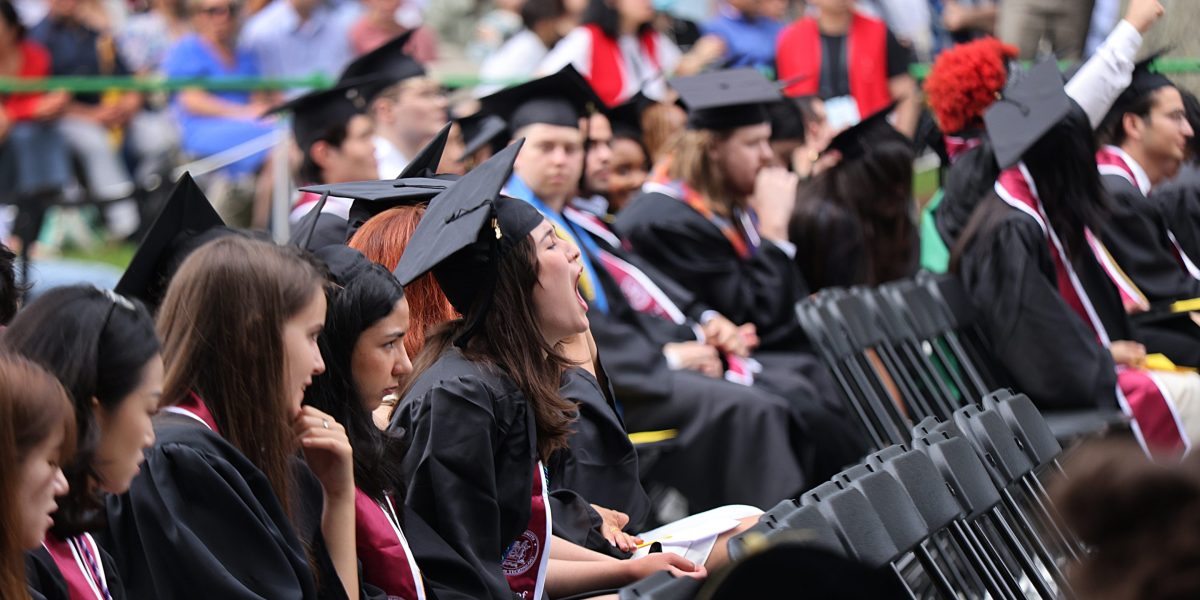
For today’s college students, attitudes toward AI can seem paradoxical.
On one hand, they’ve made their ire toward the technology clear: Former Google CEO Eric Schmidt was met with hisses during his commencement remarks at the University of Arizona’s graduation ceremony on Sunday when he invoked the inevitability of a future with artificial intelligence.
“The question is not whether AI will shape the world. It will,” Schmidt said, pausing for a moment as students booed. “The question is whether you will have shaped artificial intelligence.”
Just days earlier, real estate executive Gloria Caulfield told graduating students at the University of Central Florida, “The rise of artificial intelligence is the next industrial revolution.” One audience member jeered in response, “AI sucks.”
But the outward disgust toward the AI boom doesn’t tell the full story of the 2026 graduating class’s relationship to AI. The same cohort is also adopting the technology at a rapid clip, with 57% of U.S. college students reporting using the AI tools in their coursework weekly, and 20% using it daily, according to the Lumina Foundation-Gallup 2026 State of Higher Education study published last month.
Some are even using this tool illicitly in the classroom. Jacob Shelley, an associate professor of health law at Western University, said he was overwhelmingly convinced his students cheated on the final exam for one of his classes, with many using AI tools to do so.
“The results were anomalous,” he told Fortune, noting 8% of his class getting a perfect score on the multiple choice section of the exam while many either struggled on the essay portion or gave written responses with content Shelley hadn’t taught in class. “That just never happened in 20 years of teaching.”
Princeton University faculty voted last week to rescind its 133-year-old honor code and proctor all in-person exams to mitigate cheating using AI. Stanford University senior Theo Baker wrote in a New York Times op-ed this week that “cheating has become omnipresent” at his college.
But where some see a contradiction, experts see a peek into the minds of young graduates—the first generation of college students to experience their four-year undergraduate experience with tools like ChatGPT, launched in late 2022, at their fingertips.
Gen Z’s AI cognitive dissonance
Maitraye Das, a computer science professor at Northeastern University, studies Gen Z’s attitudes toward AI use, and a report she published last year found most college students use AI, but many don’t disclose it.
She identified the phenomenon as a form of cognitive dissonance, a psychological pattern in which a set of behaviors may contradict a belief system, leaving individuals to alter either their attitude or actions toward a certain topic.
In the case of her research, Das found students feared using AI would impede their critical thinking skills and learning goals. But at the same time, they felt they couldn’t afford not to use AI tools, feeling they would be left behind by peers continuing to use the technology.
“The job market already seems precarious to them, and so even the students that did acknowledge that, ‘Oh, if I just use AI to do my homework, that will stunt my critical thinking,’ they still kept using it because the cost of not using it felt higher to them,” Das said.
Indeed, a stagnant job market, along with tech leaders warning of mass AI job displacement, has instilled fear in many recent grads. In March, Anthropic released a report revealing that AI could theoretically take over most tasks in business and finance, management, computer science, math, legal, and office administration roles, including 94% of tasks for computer and math workers.
Concerns around AI taking certain jobs have already begun to materialize as anecdotal evidence, despite no widespread proof of AI markedly changing the labor market. Tech layoffs have topped 110,000 in the first five months of this year alone, with companies like Snap announcing it would eliminate 16% of roles, about 1,000 employees, as it leans into AI.
While students see AI as a threat, Das said, the proliferation of AI in the workplace, as well as in schools—where last year about 30% of teachers said they use AI at least weekly—has also created a justification for them to use the technology, even if it means cheating or keeping quiet about their own AI use.
“They are thinking, ‘People rather than me are using AI. Why am I held to a different standard? Why can’t I use AI?’” Das said. “So instead of disclosing their AI use or limiting their AI use, they reframe the social context to make their behavior around secretly using AI to feel more acceptable to themselves.”
How society shaped Gen Z’s AI struggles
Widespread messaging about AI in commencement speeches—typically coming from AI stakeholders—have only grown the chip on Gen Z’s shoulder around AI use, according to Das. Skyrocketing tech stock valuations and the growth of the Magnificent 7 have created a K-shape of who stands to benefit from the technology’s growth.
“Students feel that there’s a corporate mouthpiece narrative,” Das said. “They are facing this very real fear of not landing a job, and so especially the tech CEOs, when they come to these commencement stages and encourage and cheerlead AI, I think students feel a disconnect there.”
Shelley, the health law professor, agreed that students cheating with AI is less of an endorsement of the technology and rather a survival tactic—perhaps even one they resent.
“AI is going to replace them, at least a lot of them, and they know that, and we’re pretending that it won’t,” he said. “I think they see through it. So students are responsible, but I don’t really blame them here.”
Some of the blame, Shelley argued, lies with educational institutions themselves, which have advocated for students to use AI. Two years ago, Arizona State University launched a collaboration with OpenAI to develop AI tools for higher education. But overall financial aid for colleges is lower now than it was 15 years ago, forcing some students to take part-time jobs. Now strapped for time, they feel like AI is the only way to accomplish their assignments, Shelley said.
Das noted that AI authorities, including higher education institutions, have done a poor job identifying what jobs will be created as a result of AI and subsequently encouraging the appropriate form of upskilling. The overall effect is students feeling disenfranchised from their future, resorting to shortcuts that may ultimately not prepare them with the tools or values to thrive as they take their next steps into the world, the experts warned.
“The worst thing we could do is blame students here,” Shelley said. “It’s our job to teach them, to nurture them, to inspire them, to guide them. It’s our job to educate them, and it’s our responsibility as society to take a deep look and go, ‘Why has this happened?’”
