

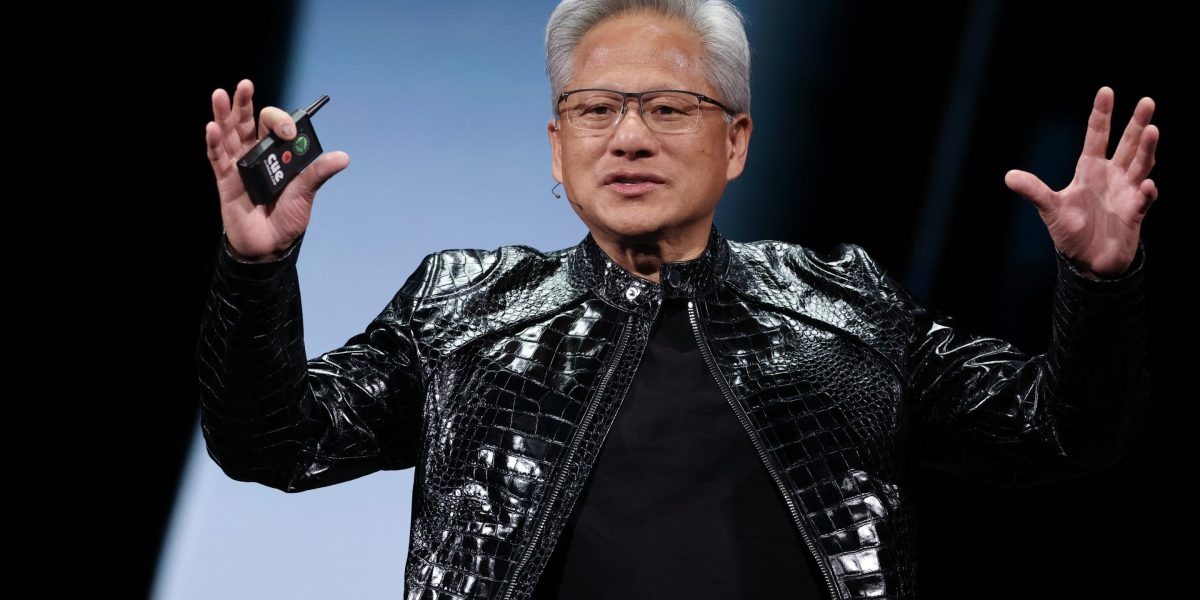
Nvidia CEO Jensen Huang’s comments on his company’s Q4 earnings call on Wednesday may one day be remembered as the peak of the AI bubble—the classic moment that occurs in every bubble when hubris and self-delusion overtake common sense.
For that not to be the case, it would mean that, beginning in 2026, the U.S. embarked on one of the greatest and most unprecedented economic expansions in history.
It’s a scenario that Huang clearly believes in. His message to investors on Wednesday: Big Tech’s massive spending on AI technology, particularly Nvidia’s chips, is not anywhere near finished. “This new way of doing computing is not going to go back,” he said, and businesses are “going to be building out this capacity from this point forward and continue to expand from here.”
Nvidia delivered absolutely blockbuster results in the final three months of 2025, as demand for its AI chips went through the roof. Revenue increased an astounding 73% to $68.1 billion, and Nvidia said sales in the current quarter would expand by as much as 78%.
If Nvidia’s stock was up less than 1% after these heroic results, it’s because there’s a fundamental problem at play. More than half of Nvidia’s revenue comes from the five big “hyperscalers”—that is, the Googles and Amazons of the world (Nvidia didn’t explicitly name the five companies, but it’s easy enough to guess who they are), who are feverishly buying as many of Nvidia’s GPU chips as they can to stuff in the massive AI data centers they’re constructing.
Many of these hyperscalers have vowed to double their capital expenditures this year as they build more data centers. Meta, which spent $72 billion on capex in 2025, plans to spend up to $135 billion this year. Google said it will spend as much as $185 billion, compared to $91 billion the year before. All told, the big hyperscalers are budgeting nearly $700 billion in capex this year.
The obvious question is: How long can this go on? These hyperscalers are already outspending their prodigious free cash flow and raising debt to finance the AI infrastructure buildout. If that group of five companies doubles capex every year, we’re looking at $2.8 trillion of spending by 2028, and $5.6 trillion by 2029.
The Wall Street analysts on Wednesday’s earnings calls asked Huang about this. How sustainable is this, really? Will the other 50% of Nvidia’s customers help keep the AI infrastructure spending spree going? What kind of applications and real-world uses will drive demand for all this new AI infrastructure?
Huang walked through the logic for perpetual spending as calmly and confidently as a professor explains a simple math problem to a student.
“If you think about it and said ‘OK, well the world was investing about $300 to $400 billion a year in classical computing, and now AI is here and the amount of necessary computation is 1,000 times higher… if we continue to believe there’s value in it, then the world will invest to produce that token,” Huang said, referring to the basic unit of data processed by AI models.
“So the amount of token generation capability that the world needs is a lot more than $700 billion,” he continued. “And I’m fairly confident that we’re going to continue to generate tokens, we’re going to continue to invest in compute capacity from this point out.”
In terms of applications, the recent buzz around AI agents and tools like Open Claw is already creating a new wave of demand. “Agentic AI has reached an inflection point, and it literally happened in the last 2 or 3 months,” Huang said. After agentic AI, he added, there will be physical AI, as new AI models are integrated into robotics and manufacturing equipment.
“AI is here. AI is not going to go back. AI is only going to get better from here,” Huang said.
In other words, the party is just getting started and the music is not about to stop. At least not to Huang’s ears.
Correction: An earlier version of this story misstated Nvidia’s revenue guidance.
