

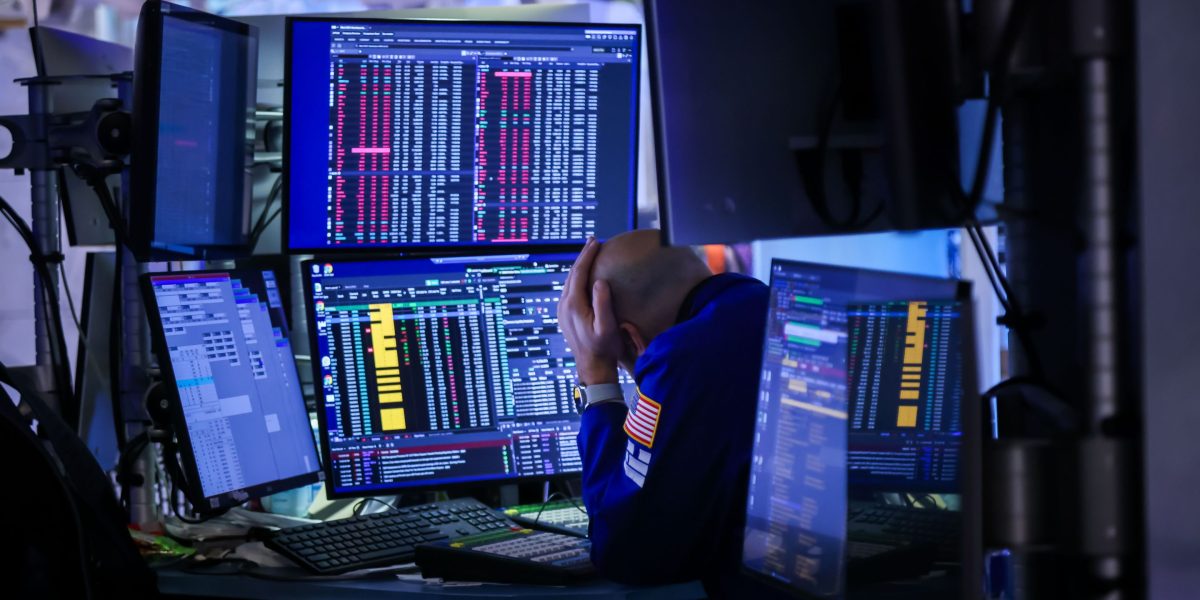
Markets are not in a comfortable place right now. The S&P 500 was down by more than a percentage at yesterday’s close, the Dow Jones by near the same, and the Nasdaq was down nearly 2%. The VIX volatility index, by contrast, is up more than 9%—suggesting the turbulence is far from over.
Even then, Apollo’s chief economist, Torsten Sløk, wrote this week the S&P is at “historically extreme valuations.” In a note to clients yesterday, Sløk charted the “Warren Buffett indicator” (U.S. stock market cap to GDP) against the Shiller cyclically adjusted price-to-earnings ratio.
The result is—perhaps unsurprisingly—that over time the Buffett indicator has increased toward the exteme end, as has price-to-earnings. However, 2025 stands out as a particularly extended outlier.
The latest data underlines a broader concern among analysts that a reckoning is looming for the markets. The CEOs of both Morgan Stanley and Goldman Sachs have stated this week that they foresee a significant selloff ahead, with markets potentially adjusting down by as much as 20% over the next two years.
High valuations themselves don’t necessarily signal an imminent correction, argued UBS’s chief investment officer, Mark Haefele, in a note to clients yesterday. He said that on the whole there is “no doubt” that valuations are above average but the market is unlikely to correct itself based purely on this fact.
Instead, he argues, declines will come “when corporate profit growth disappoints, with forward returns more correlated with changes in earnings expectations over the next 12 months.”
He added: “Results from the current earnings season have been solid, with both the breadth and magnitude of earnings beats so far exceeding historical averages. We forecast S&P 500 earnings per share to grow 10% this year, and see upside to our expectation of a 7.5% growth next year. Additionally, we believe current valuations are justified, as the increased weighting of higher-multiple sectors (such as IT) in equity benchmarks should help sustain higher valuations.”
It would be remiss not to mention the driver of valuations: AI. Capex on the revolutionary technology isn’t only pumping valuations in markets, it’s so huge that it’s a key driver for the U.S. economy as a whole. The level of funds being pumped into AI and its infrastructure has led to (arguably inevitable) bubble questions about whether the technology can live up to its promise.
“Given aggressive valuations, however, investors must be asking where the fuel for 2026 gains will come from,” chimed Lisa Shalett, chief investment officer at Morgan Stanley in a note on Monday. “In essence, portfolio positioning hinges on whether the AI capex boom will deliver as modeled. Our view remains 50/50, given that implementation may take longer than hoped for, with productivity gains limited to a few scaled companies.”
Of course, valuations also comes down to timing: When does the market see companies finally delivering the results they are being valued on?
This is the argument of Mary Callahan Erdoes, CEO of JPMorgan’s asset and wealth management business, who acknowledged that while in some stocks there is “a little too much concentration,” argued at Fortune’s Global Forum last month: “AI has not even been deployed anywhere to the extent that it will be. Less than 10% of companies actually say that it’s embedded in the services and the products that they deliver today. There’s an enormous amount of opportunity.”
She added: “That’s why you’re seeing the multiples are the way they are. And the question is, how fast will we grow into those multiples? It’s not that the multiples are wrong, they will eventually be right; they may not be right for every company.”
Here’s a snapshot of the markets ahead of the opening bell in New York this morning:
S&P 500 futures are up 0.17% this morning. The last session closed down 1.12%.
STOXX Europe 600 was flat in early trading.
The U.K.’s FTSE 100 was down 0.48% in early trading.
Japan’s Nikkei 225 was down 1.19%.
China’s CSI 300 was up 0.31%.
The South Korea KOSPI was down 1.81%.
India’s NIFTY 50 is down 0.1%.
Bitcoin was down to $100.9K.
