

Oracle called the third quarter of fiscal 2026 its best in 15 years with revenue up 22% to $17.2 billion and cloud infrastructure up 84% to $4.9 billion. The market rejoiced, sending the stock up nearly 10% in after-hours trading on Tuesday.
Despite the market’s ebullience, the enterprise software giant is blowing through cash at a steadily rising pace. Just three quarters ago, Oracle’s free cash flow was essentially zero, and this quarter it clocked in at negative $24.7 billion over the trailing 12 months as its capital expenditures rocketed from $21.2 billion in fiscal 2025 to a guided $50 billion this fiscal year as the company forges ahead in its AI data center buildout.
Chief financial officer Doug Kehring said after the market closed that Oracle would offer up more information about its capital expenditures for fiscal 2027 next quarter.
“I think we’ll get back to everyone at the end of the fiscal year and talk about next year’s capex at that point,” said Kehring in response to a question. However, he flagged that Oracle is working on financing structures where future spending doesn’t come out of Oracle’s pocket but instead can be paid for by customers paying for capacity and services. “The most interesting thing that you can start thinking about is the uncoupling of CapEx with capital requirements from Oracle,” Kehring said.
Oracle, whose market cap is more than $400 billion, has been shadowed by questions about its aggressive capital spending and mounting debt load. The company guided capex of $50 billion for the current fiscal year, a figure that has helped push its total debt position to more than $100 billion. Last month, Oracle raised $30 billion through a one-two punch of bonds and preferred stock, and said its order book was substantially oversubscribed by investors.
For now at least, the company is delivering strong results as the bet plays out.
At the topline, Oracle on Tuesday reported fiscal third quarter earnings per share up 21% at $1.79, planting it several notches above Wall Street’s expectations of about $1.71 in adjusted earnings per share. The results sent the company’s stock price on an immediate tear in after-hours trading, an ‘Uno reverse’ on the stock’s roughly 20% tumble so far in 2026.
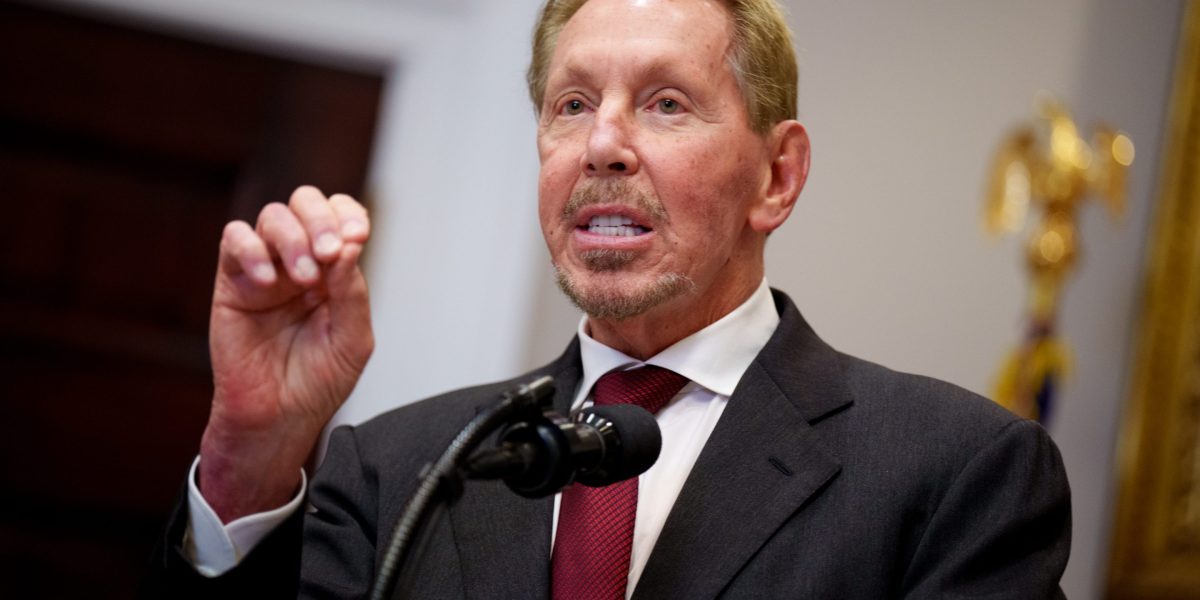
Oracle executives, including Executive Chairman and co-founder Larry Ellison repeatedly stressed that the company’s enterprise software was not at risk of being displaced by business customers using AI tools to build their own versions of the product. Ellison said Oracle is using AI coding tools to build ecosystem automation platforms for hospitals, financial services firms, and retail operations.
“That’s what we’re doing at Oracle,” said Ellison. “That’s why we think we’re a disruptor. That’s why we think the ‘Saaspocalpyse’ applies to others, but not to us.”
A half-trillion dollar backlog
Cloud infrastructure revenue, Oracle’s fastest growing business unit and a key driver behind its AI ambitions, clocked in at $4.9 billion, with 84% growth year-over-year. The figure was in line with consensus estimates and continues along with Ellison’s vision of competing with Amazon and Microsoft in the cloud market.
Total cloud revenue was $8.9 billion and up 44% year-over-year. Its multi-cloud database revenue slice—the amount Oracle earns from running its database software inside competitors’ clouds—was up 531%. That piece is part of Ellison’s strategic plan of threading Oracle into the ecosystems of Amazon’s AWS, Google Cloud, and Microsoft Azure, rather than prodding customers to move their data into Oracle’s infrastructure.
The company didn’t give specific numbers for multi-cloud revenue, but noted that its remaining performance obligations (RPO), which refers to its backlog of contracted future work—was $553 billion. That figure is evidence of demand outpacing supply, said Magouyrk. He added that Oracle signed more than $29 billion in new contracts since last quarter, in a model in which customers fund the capacity buildout themselves.
“A combination of bring-your-own hardware and upfront customer payments enables us to continue expanding without any negative cash flow,” said co-CEO Clay Magouyrk. He noted that Oracle delivered more than 400 megawatts of capacity to customers in the third quarter, with 90% of it on or ahead of schedule.
“It’s unprecedented to be scaling capital into a business so quickly while also increasing profitability,” said Magouyrk during the conference call. “As our business is going through this hyper-growth phase, that’s the only drag on profitability.”
Melissa Otto, head of research at S&P Global Visible Alpha, said Oracle’s debt-to-equity ratio stands between 3x and 4x depending on how it’s defined, which is “pretty significant leverage.”
“The investment community will want to hear what they’re going to do to ensure that the company remains on the right trajectory given that level of leverage,” said Otto in an interview before the earnings results.
Next quarter, Oracle’s C-suite said it expects revenue to grow 19% to 21% and revenue for the full year is expected to be $67 billion. Fiscal 2027 guidance was raised to $90 billion.
“High-growth companies are willing to take a hit in the near term” in pursuit of an outsized gain over the long-term, said Otto, but investors are looking for evidence along the way that capex is translating into return on invested capital, margin expansion, and revenue growth, she said.
“When I look at balance sheets and cash positions of the hyperscalers in the space, they’re very good with the exception of Oracle,” she said.
