

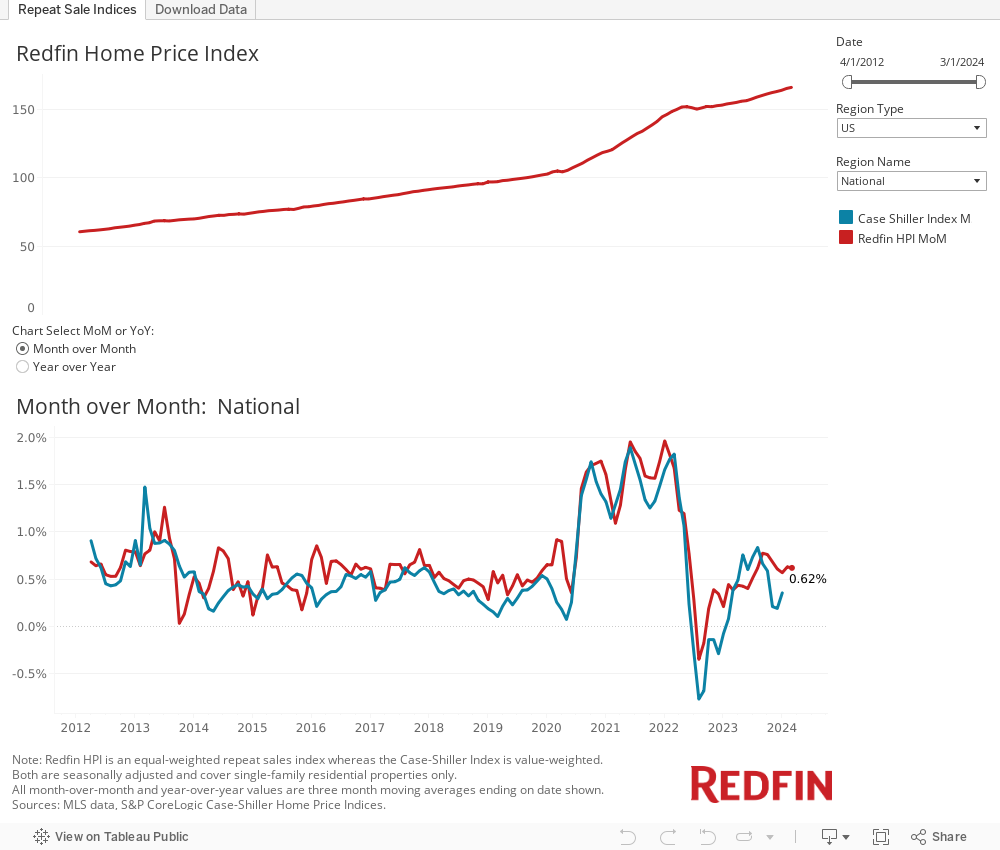
U.S. home prices rose 0.3% from a month earlier in January on a seasonally adjusted basis, and increased 2.1% year over year.
Prices fell month over month in 14 major metros, with the biggest declines in Warren, MI, San Antonio and Minneapolis.
U.S. home prices crept up 0.3% month over month in January on a seasonally adjusted basis, following a 0.2% gain in December.
Prices rose 2.1% from a year earlier, down from December’s 2.4% increase. Year-over-year price growth has now slowed for nearly 12 consecutive months.
var divElement = document.getElementById(‘viz1771271247438’); var vizElement = divElement.getElementsByTagName(‘object’)[0]; if ( divElement.offsetWidth > 800 ) { vizElement.style.width=”1000px”;vizElement.style.height=”850px”;} else if ( divElement.offsetWidth > 500 ) { vizElement.style.width=”1000px”;vizElement.style.height=”850px”;} else { vizElement.style.width=”100%”;vizElement.style.height=”1450px”;} var scriptElement = document.createElement(‘script’); scriptElement.src=”https://public.tableau.com/javascripts/api/viz_v1.js”; vizElement.parentNode.insertBefore(scriptElement, vizElement);
This is according to the Redfin Home Price Index (RHPI), which uses the repeat-sales pricing method to calculate seasonally adjusted changes in single-family home prices. The RHPI measures how sale prices of homes have changed since their previous sale—similar to the S&P Cotality Case-Shiller Home Price Indices—but is reported about a month earlier. January data covers the three months ending Jan. 31, 2025. Read the full RHPI methodology here.
Price growth is muted because it’s the strongest buyer’s market in recent history—for those who can afford to buy. Many Americans are holding off on purchasing homes because mortgage rates are still more than double the all-time low hit during the pandemic. As a result, there are a record 47% more sellers than buyers, meaning that the buyers who are in the market have negotiating power when it comes to price. Prices are still rising slightly, but this growth pales in comparison to recent years; during the pandemic, prices rose as much as 21% year over year.
“Mortgage rates have dipped in recent weeks, which has boosted purchasing power for house hunters, but a lot of folks are still waiting to buy until rates drop further,” said Chen Zhao, Redfin’s head of economics research. “The good news is that in the meantime, price growth is limited and buyers have room to negotiate concessions from sellers.”
The average 30-year fixed mortgage rate currently sits at 6.09%, down from nearly 7% a year ago.
Home prices are falling in 14 major U.S. metro areas
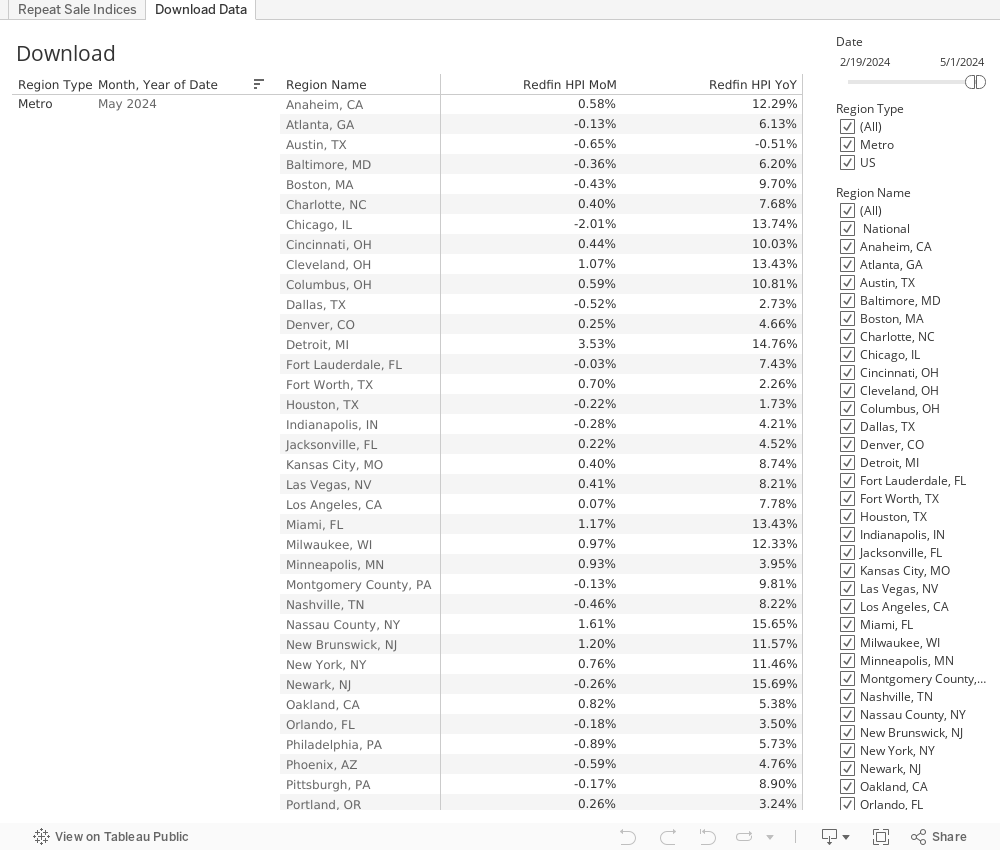
Home prices fell in 14 of the 50 most populous U.S. metropolitan areas month over month on a seasonally adjusted basis in January.
The biggest declines were in Warren, MI (-1.5%), San Antonio (-1%), and Minneapolis (-0.8%). The biggest increases were in Philadelphia (2.6%), Providence, RI (2.5%) and San Francisco (2.1%).
On a year-over-year basis, prices fell in 16 metros, with the biggest declines in Austin, TX, (-4.2%), San Antonio (-3.8%) and Jacksonville, FL (-3%). The largest gains were in San Francisco (14.3%), New York (11.1%) and Milwaukee (9.2%).
var divElement = document.getElementById(‘viz1771271266872’); var vizElement = divElement.getElementsByTagName(‘object’)[0]; if ( divElement.offsetWidth > 800 ) { vizElement.style.width=”1000px”;vizElement.style.height=”850px”;} else if ( divElement.offsetWidth > 500 ) { vizElement.style.width=”1000px”;vizElement.style.height=”850px”;} else { vizElement.style.width=”100%”;vizElement.style.height=”1450px”;} var scriptElement = document.createElement(‘script’); scriptElement.src=”https://public.tableau.com/javascripts/api/viz_v1.js”; vizElement.parentNode.insertBefore(scriptElement, vizElement);
The post U.S. Home Prices Crept Up 0.3% in January appeared first on Redfin Real Estate News.
