

In This Article
As if house prices and insurance weren’t expensive enough, throw soaring property taxes in the mix, and you have the holy trinity of unaffordability, eating into cash flow like termites into untreated wet wood.
According to a recent analysis by the Urban-Brookings Tax Policy Center, cited by CBS News, the median property tax bill in the U.S. rose 30% between 2019 and 2024. However, there is a vast discrepancy between states. WalletHub reports that the average American household now pays roughly $3,119 a year in property taxes, according to the U.S. Census Bureau, with effective rates over eight times higher in the costlier states than in the cheapest.
Almost 50% of the Median Income Goes to Principal, Interest, Taxes, and Insurance (PITI)
The Atlanta Federal Reserve’s Home Ownership Affordability Monitor highlighted the combined effect of rising costs. According to the findings, the median-priced home in late 2025 required 42% of the median income. To put it in perspective, the median principal interest and mortgage payment with taxes, homeowner’s insurance, and private mortgage insurance doubled in a five-year period between June 2020 and June 2025, increasing from $1,564 to $3,114—far outpacing wage growth. Some cities, such as Nashville, are higher.
Doug Duncan, former chief economist of Fannie Mae and founder of Duncanomics, laid some of the blame at the Fed’s feet. Duncan told Bankrate:
“That role is having driven real interest rates negative and nominal interest rates essentially to zero, which brought mortgage rates down to the 3% range for a sustained time period. There was no rational reason why rates should have been that low, that long, or even that low to begin with. But the fact that rates were that low [for] that long moved a whole bunch of people forward in time with a once-in-a-lifetime opportunity to lock in an unreasonably low interest rate. Of course, that stimulated demand, which accelerated the pace of price appreciation.”
The Vicious Cycle of Rate Hikes, Low Inventory, and Soaring Prices
The escalating cost of owning a rental has made the idea of achieving short-term cash flow as difficult as threading a needle in a hurricane. The post-pandemic interest rate hike led to a lack of inventory as potential sellers held on to their low rates and buyers balked at buying homes they could no longer afford.
Factor in the increase in prices, tax assessments, and taxes, and extreme weather was the final nail in the coffin, driving insurance costs skyward.
A Bloomberg analysis of ATTOM data found that in 2023, tax levies on single-family homes climbed 6.9%, the biggest increase in five years, with the average homeowner’s tax bill around $4,000.
Thomas Brosy, Tax Policy Center senior research associate, wrote in a September blog post:
“Surging home values have amplified calls to cut or even abolish the property tax. Because property taxes rise with home values, homeowners may fear being squeezed by larger tax bills. Those fears aren’t unfounded: The median bill rose about 30% between 2019 and 2024—still far short of soaring home values, but with wide variation across states.”
Where Cash Flow Is Under Pressure From High Taxes
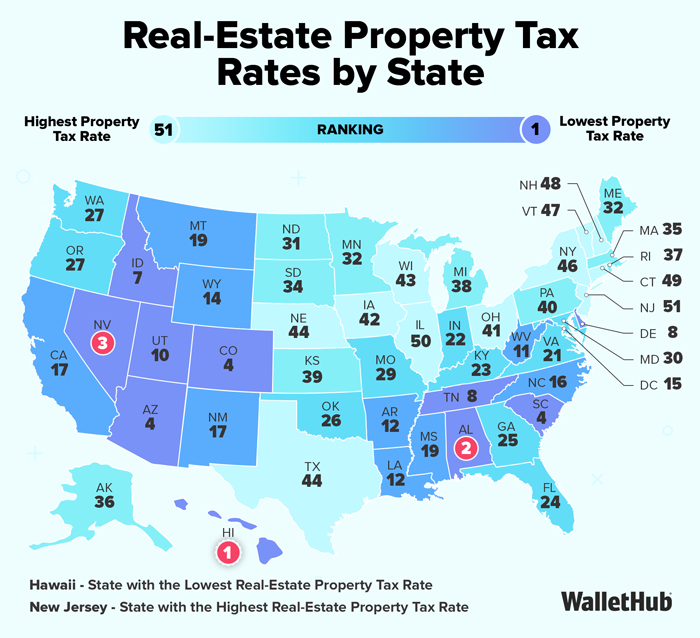
Unless you have owned a rental property in New Jersey for a very long time or purchased it free and clear, good luck seeing any cash flow. That’s because it has the most expensive effective property tax rate in the country, followed by Illinois and Connecticut. As of early 2026, the average home price in New Jersey was $558,805, according to Zillow figures, which would mean an almost $12,000 tax bill.
By contrast, the lower real estate tax states of Hawaii and Alabama have rates in the 0.27% to 0.38% range, putting their average annual tax bills at a far more manageable $2,239 and $788, respectively.
The combined burden of high taxes and insurance now exceeds mortgage payments in many areas, according to a 2024 Wall Street Journal article citing data from Intercontinental Exchange. The constant upward pressure on expenses forces landlords to raise rents, tightening the squeeze on affordability.
Top 10 states with the lowest property taxes
Hawaii: 0.27%; $2,239 average annually
Alabama: 0.38%; $788 per year
Nevada: 0.47%; $2,027 per year
Arizona: 0.48%; $1,879 per year
Colorado: 0.48%; $2,602 annually
South Carolina: 0.48%; $1,251 yearly
Idaho: 0.49%; $2,038 per year
Delaware: 0.50%; $1,768 annually
Tennessee: 0.50%; $1,442
Utah: 0.52%; $2,525 annually
Top 10 states with the highest property taxes
You might also like
New Jersey: 2.11% effective rate; average of $9,590 annually
Illinois: 2.01%; $5,298 per year
Connecticut: 1.81%; $6,643 annually
New Hampshire: 1.66%; $6,667 yearly
Vermont: 1.59%; $5,039 annually
New York: 1.55%; $6,582 annually
Nebraska: 1.49%; $3,549 per year
Texas: 1.49%; $4,232 annually
Wisconsin: 1.42%; $3,792 yearly
Iowa: 1.39%; $2,897 annually
Why Tax Math Is Never That Simple for Investors
It could never be as simple as “low taxes good, high taxes bad,” could it?
Yes, on an even playing field, low taxes would mean more cash flow and high fives all around. However, in the U.S., the playing field is more like the lip of a volcano, and high-tax states often have better schools and infrastructure, and consequently higher rents, because more people want to live there.
Lower-tax states may depend on other revenue sources, such as sales or income taxes, to fund local services, which means a landlord might incur greater costs for renovation materials. Overall, when lower-tax states strain school and infrastructure budgets, desirability drops along with rental and tenant incomes.
There are pros and cons to every market, and taxes are only part of the equation. For example, Florida, considered a low-tax haven, is not that low when it comes to real estate taxes, which have increased 9.5% per year from 2019 to 2024, as property prices climbed 14.6%, according to a report by Cotality.
Final Thoughts
Many landlords, including me, can attest that choosing a market and rental property based on paper cash flow alone is a big mistake. Low taxes, insurance costs, and prices, as well as decent rents—what’s the catch? If something’s too good to be true, it often is.
While there are many affordable markets in the Midwest, Pennsylvania, and the South, where, in theory, it is possible to cash flow, investors must prepare for a dip in local economies, secure higher-paying jobs, and have access to a quality tenant pool. There is also increased turnover, as well as management and maintenance costs.
Higher taxes do come with a trade-off, but usually it isn’t so bad—better schools, lower crime, higher rents, and better-qualified tenants. In the current market with interest rates, taxes, and insurance at high levels, cash flow—like the penny-farthing bicycle and bonnets—seems like a quaint concept from a bygone era.
This is the long-game era. Buy a high-quality rental in a decent neighborhood at the best price you can, for tax benefits, high demand from stable tenants, and long-term appreciation. Eventually, it will start cash flowing and stacking on equity—and that’s when you’ll look like a genius.
