

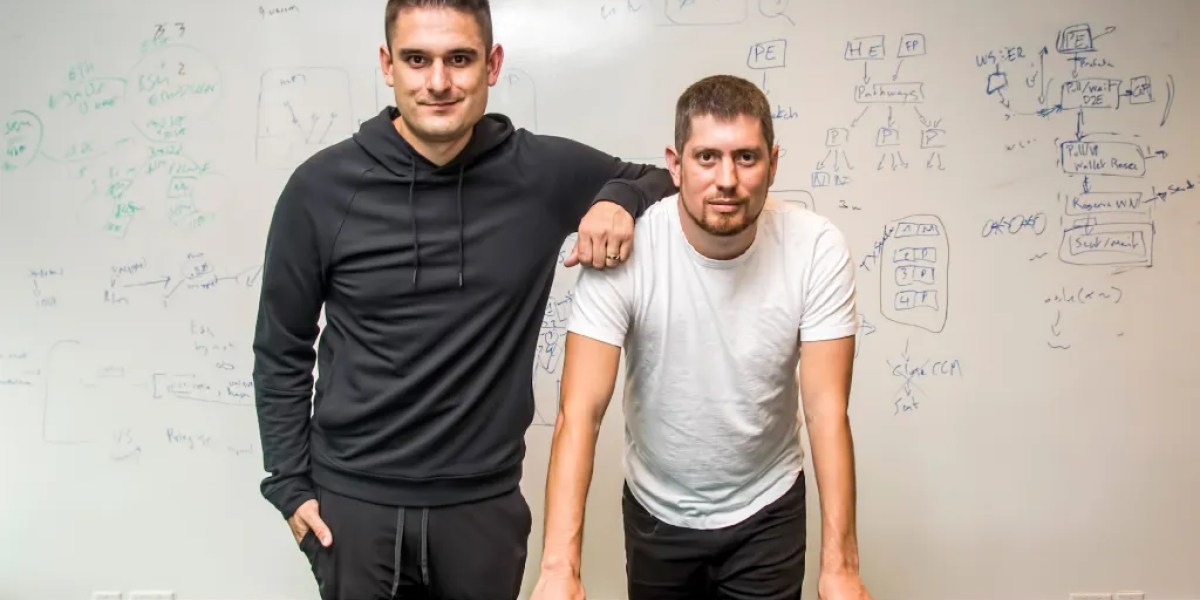
As Wall Street embraces blockchain technology, the crypto industry is still dealing with an existential problem: how to scale the tech so that it can handle the massive volume created by traditional finance entities like the New York Stock Exchange. Meanwhile, big banks and trading firms are seeking reassurances that their sensitive client data does not appear on the public ledger of a blockchain like Ethereum or Solana. One startup believes it has found a way to address these concerns. On Tuesday, the Andreessen Horowitz and Sequoia-backed crypto company LayerZero announced a proposed solution: a new blockchain called Zero designed to meet the needs of Wall Street.
Though a slew of previous blockchain companies have purported to build TradFi-grade trading infrastructure, LayerZero is also announcing an impressive array of Wall Street players who are coming on board as investors, partners, and advisors, including the market-making giant Citadel Securities as well as ARK’s Cathie Wood and Intercontinental Exchange, parent company of the New York Stock Exchange.
In an interview with Fortune, cofounder Bryan Pellegrino said that the Zero blockchain can overcome the scaling challenge thanks to a breakthrough on a cutting-edge type of technology known as zero-knowledge proofs, which allows different parties to verify information in a privacy-preserving method.
“[LayerZero] has such an expansive understanding of what’s going on in the markets,” Wood told Fortune. “Really bringing internet speed to finance—that’s a big idea.”
Zero-day
Founded in 2021, the Vancouver-based LayerZero initially focused on building technology to connect the sprawling landscape of blockchains, allowing decentralized applications to send tokens and information between different networks. The company was a darling of the last bull market, raising a $120 million funding round in 2023 from Andreessen Horowitz (a16z) and Sequoia that valued the startup at $3 billion. The former also announced last April that it had bought an additional $55 million worth of LayerZero’s proprietary token, ZRO, which currently has a market capitalization of over $500 million.
Zero takes a different approach by competing with other blockchains, rather than serving as an infrastructure layer for them. Pellegrino explained that the decentralized nature of blockchain networks makes it difficult to handle a large throughput of transactions at a cost-effective price. By reapproaching the foundational technology of zero-knowledge proofs at first principles, Pellegrino says that his company’s new blockchain can manage 2 million transactions per second at a fraction of a cent per transaction, whereas Solana’s previous max is 100,000.
LayerZero plans to hold a demonstration of the blockchain on Tuesday, though it will not launch until September. (Pellegrino says that they were able to achieve the breakthrough partly by hiring two of the world’s leading ZK engineers and programmers, whose names are still secret even to the majority of his 165-person company.)
The upshot, if Zero proves out, is that institutions like the DTCC handling trillions of dollars worth of assets might be more likely to turn to blockchain infrastructure. Many of these firms have announced pilots and experimentation with tokenization, or issuing financial assets on blockchains, including the NYSE. Some critics, however, have argued that the plans mostly amount to marketing without real integration.
“One of the key hurdles has been speed and transactions per second,” Wood said. “This is in a completely different league.”
Pellegrino pointed to the partners coming on board as evidence that LayerZero will help break the logjam of Wall Street’s blockchain adoption. That includes Citadel, which is making an investment into LayerZero through a token purchase, though they declined to specify the deal size. The stablecoin giant Tether also announced it would be investing in the company, as well as ARK.
Citadel, whose capital markets arm handles around 35% of retail stock trades in the U.S., has faced pushback in the crypto industry after arguing to the Securities and Exchange Commission that decentralized finance should be regulated in a similar manner to its traditional counterpart. But Pellegrino said that LayerZero’s focus wasn’t the sector’s feelings toward Citadel, but bringing on board the global institutions with the most market structure experience.
“When you think about the next few years, how do markets move from 7/5 to 24/7—what does it look like when markets move entirely global?” Pellegrino said. “How do you actually build those markets for the future?”
At this point, everything is still theoretical, from the Zero blockchain itself to how the NYSE integrates decentralization into its core infrastructure. When asked how the NYSE would adopt Zero, Pellegrino said that he doesn’t want to speak on behalf of the company, arguing that it couldn’t currently manage its systems through blockchain owing to cost and speed issues.
“It’s not what exists today,” said LayerZero cofounder Raz Zarick. “But something that actually uses 2 million transactions per second is the future world economy.”
